
Victor Siyanbola
It is universally acknowledged that literature shares a symbiotic relationship with society. As a matter of fact, writers of literary works are inspired via various sources which include the need for a social change. In most cases, this quest for social change is initially regarded as an expression of radicalisation. Notwithstanding, satire, a literary genre, aims to pass an authorial comment on an ailing society and seeks to enforce a movement towards amelioration.
The backdrop of “Tell this White Man Clown” can be traced to a memorandum that was released on July 16, 2024. In a journey down the lane of memory, the UI management issued a memorandum on electricity rationing for UI on-campus residents. It was stated therein that electricity would be supplied for only 10 hours per day. Unfortunately, this development met the students’ innate anger as the electricity was not restored as and when due, as stated in the memo. In consequence, students staged a protest as a demonstrative mechanism in a bid to stem the tide of the management’s aloof treatments towards them. Lecture theatres were closed and concerned students participated in the protest.
In the early hours of July 17, students left their comfort zones and joined the peaceful demonstration. With placards having inscriptions like: “From 55k to 200k+ shey fe pa mi ní??? Fees must fall”, “reversal: no to 10 hours power supply”, concerned and rather embattled students expressed their grievances towards the outrageous hike in education costs as well as the electricity rationing. As a result, Otoyin, a talented poet in the Department of English, Faculty of Arts, wrote this satirical piece under review.
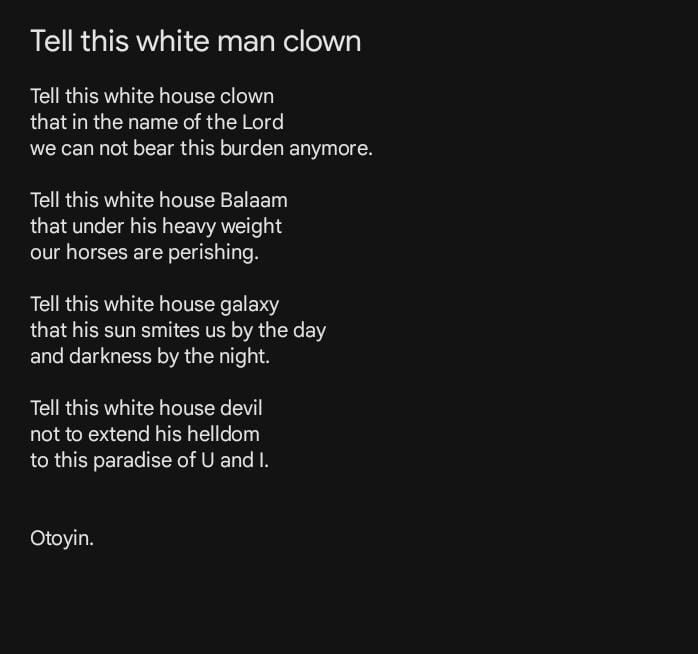
The title of the poem, Tell this White Man Clown, is a metaphorical expression that gives an instruction about the poet’s referent. His use of ‘white clown’ gives an impression of the expertise of this old clown archetype. A white clown or whiteface clown covers his entire face and neck with a white makeup, and it is impossible for anyone to see his underlying natural skin. As a satirical piece, Otoyin’s choice of the clown archetype serves as a facile attempt to portray leaders whose abuse of power have resulted in a loss of moral compass and those that have become a law unto themselves. The directive impulse to “tell this white clown” requests an action from the audience, which in this case was the protest.
“Tell this white house clown
That in the name of the Lord,
We cannot hear this burden anymore.” (Lines 1-3).
These lines run into one another, giving insights into a bug of frustration that persists. The use of “we”, first person plural pronoun, endorses the poet’s esprit de corp i.e. sense of belonging. The third line points out a burden that has been borne for a long time. However, Otoyin recommends that the only way to pull the plug on this long-term malady is to confront the referent, that is to say, a direct challenge against a tyrant. In other words, the poet admonishes readers, who are under oppressive situations, to speak up for themselves and fight for emancipation without a modicum of hesitation.
“Tell this white house Balaam
That under his heavy weight,
Our horses are perishing.” (Lines 4-6).
The biblical reference in line 4 alludes to Balaam, a prophet who could rain blessings and curses on people at will. Influenced by pride and wickedness, he wanted to curse some people who fought his nation. Likewise, he wanted the king to send his highest ranking officials and offer him huge sums of money. Hence, this poem also strongly comments on leaders who exude pride and wickedness as metaphorically represented by “heavy weight” (l. 5), as well as leaders whose actions are under the influence of being “above, superior and more powerful.”
“Tell this white house galaxy
That his sun smites us by the day
And darkness by the night.” (Lines 7-9).
The poet explores the interplay between what is owned and its owner. “The sun” in line 8 is a symbolic representation of the power that a leader wields. Touching on the notion of the referent’s dreariness, the poem bemoans that “his sun smites us by the day/and the darkness by the night.” The profundity of what these lines foreground is rooted in line 9 when he implies that darkness, and not the moon, smites by the night. In this context, this leader has grown so uncontrollable that his modus operandi weakens the strength of his victims and even prevents them from knowing this.
“Tell this white house devil
Not to extend his helldom
To this paradise of U and I.” (Lines 10-12).
In the last stanza, he portrays the leader as a devil who has a helldom. In contrast, Otoyin presents the salubrious ambience of where “U and I” take solace by terming it a “paradise”. Hence the call for action is directed to his readers to expressively stand against every leadership style that afflicts their euphoria through the forces of tyranny, autocracy, exploitation and high-handedness.
In conclusion, George Orwell’s definition of leadership gives an insight into who a leader should be. According to him, “leadership is not a pleasure but a deep and heavy responsibility.” Leaders should be mindful of the responsibility engraved in their hands, and they must desist from seeking self prosperity and comfort. Likewise, a true leader should be “a leader who knows how to follow”, in line with Niyi Osundare’s perspective.
 NASELS Press University of Ibadan
Leave a comment