
Adebowale Aminat
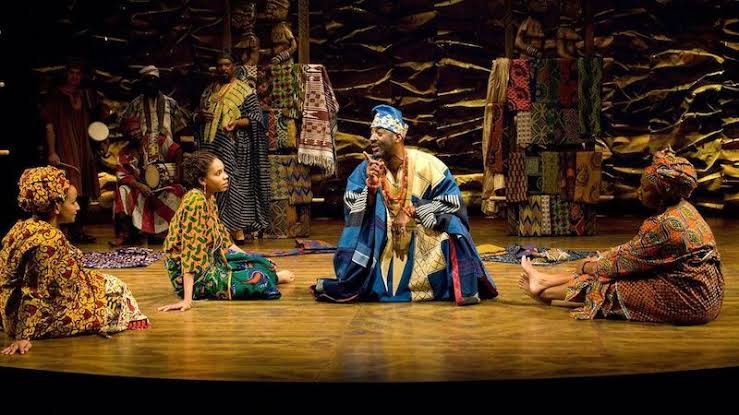
Wole Soyinka’s Death and the King’s Horseman, which was written in 1975, was first adapted into a movie and directed by Peter Brook, a renowned British director in 1986. The movie adaptation of Death and the King’s Horseman by Brook added a cinematic depth to the narrative, using film technique to enhance the audience’s engagement with the story. After Peter Brook’s 1986 adaptation, the play has primarily been celebrated and studied in its original theatrical form. The theatrical stage enactment of the play was an avenue for the audience to witness first hand, the cultural depth of Yoruba culture and tradition.
Central to the play is the enactment of ritual performance, which are integral to Yoruba culture and tradition. The play which centres around the main character named Elesin Oba was brought to life at the market place with a prologue made by Olohun Iyo, two characters who served as the chorus of the whole play. Olohun Iyo made it known to the audience the circumstances surrounding the imminent death of Elesin Oba. Elesin Oba is someone who wines and dines like the King and is always prepared to die with the king after that particular King’s demise. It is to their belief that Elesin Oba’s death is necessary so as to ensure the safe passage of the dead King to the other world.
Elesin Oba, who is aware of his fate and had lived like a king all his life, was shown having lively conversations, mesmerising and enjoying his few last moments on earth with the market women. It was during this moment that his eyes caught a beautiful damsel who turned out to be the wife-to-be of the son of Iyaloja. Putting his status first, he met with Iyaloja and proudly stated his interest in having her son’s wife-to-be. Having little to no choice, Iyaloja conceded and stated that Elesin Oba is willing to go to his grave through the same passage that brought him to the world. Having satisfied himself with Iyaloja’s son’s wife-to-be, he was caught in-between a conflicting obligations his personal desires and societal duties.
Meanwhile, the play which is laced with the themes of colonialism and the clash between traditional African values and Western influence has the antagonists, Mr and Mrs Pilkings who after being informed of the situation, saw the culture as barbaric and made sure they did everything possible to stop the death of Elesin Oba. Conflict was inevitable when Mr Pilkings got Elesin Oba arrested and stopped him from performing his cultural duty. In his words, the culture is the thinking of the ‘backward race’. He saw no sense in the death of a King resulting in the suicide of another person.
Mr Pilkings was counter argued by Olunde, the son of Elesin Oba, who created an analogy between the death of an Elesin Oba and the whites that die at warfront. According to Olunde, both parties are dying for a cause. To the Pilkings, they are terminating an innocent life, but to the culture, the soul of Elesin Oba lives on in the spiritual realm. Unbeknownst to Olunde that his father is yet to die, he unapologetically opposes the Pilkings while supporting his cultural heritage.
The Pilkings are surprised that Olunde, whom they have sent abroad to study for quite a number of years, could still have such a patriotic stance with his ‘barbaric’ culture. Being in the captivity of Mr Pilkings, Elesin Oba became a subject of mockery receiving insults from his son, Iyaloja and the whole community. His unwillingness to die sparked more contempt from those who had loved and honoured him.
The play which operates on multiple levels, employing symbolism and allegory to explore the theme of cultural identity made Olunde to take upon himself the responsibility of his father, and commit suicide. Elesin Oba’s selfishness, eventually, results in the loss of his own son, who took his place as the king’s horseman to restore order. In the end, faced with the catastrophe his selfishness has caused, Elesin Oba does commit suicide — but it is not enough to set things right or return his honour..
Overall, Death and the King’s Horseman stands out for its depth of cultural insight with the marriage of Yoruba proverbs and imagery which add layers of meaning and cultural resonance, poetic language that elevates the dialogue and enhances its emotional impact, and exploration of universal themes through a distinct African lens, making it a unique and powerful work in both literature and theatre.
 NASELS Press University of Ibadan
Leave a comment