
Siyanbola Victor
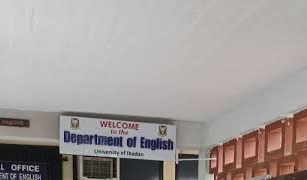
The Department of English, University of Ibadan, is analogous to a mother who gives birth to some children. She nurtures them and prepares them for the uncertainty, with a fit of hope for a better tomorrow. Years later, at the wake of each day comes a beautiful grin on her face when she recalls how great her children are doing in life. Can she be any more proud of them?
Established in the year 1948, the 75-year-old Department of English, UI, has never failed to fulfil its mandate at its full course. As a nulli secundus, the department is teeming with vastness in language, linguistics, literary and cultural studies. Hitherto, she has always been an institutional beacon for the development of the intellect and the refinement of character. Little wonder, scholars who have tread her path are doing exploits in the world of literature.
Literature is the cocaine of human expression – a jolt of condensed life packed into lines we snort, inject, or smoke to escape our mundane realities. It is the ladder we climb to peek into others’ bedrooms, to love dangerous experiences from the safety of our armchairs. (Cristian Mihai). Reading, analysing, and critiquing good literature that subsists in literary standards posit ways through which the reader’s mind journeys through diverse fields of life. In the world of literature, there is an exposition of thoughts, ideas, and perspectives from authors. Hence, channelling cross-national circulation of literary works, peculiar poetics, and cultural values.
Leaving the institution in 1954, Chinua Achebe is one of the prolific authors produced by the Department of English, UI. For Achebe, literature serves as a means to take to the international stage cultural values, proverbs, and folklores peculiar to Nigeria. A reader of his books will confirm that he infuses language as a repository of wisdom and cultural values. The proficiency of the department in grooming world leaders is also evident in the fact that his debut novel, Things Fall Apart is the greatest story in Modern African Literature. Achebe, in his works, offers a nuanced portrayal of Igbo and Nigerian culture, traditions, and customs. (Igboko). Other books of repute by Achebe are Arrow of God, A Man of The People, Anthills of The Savannah, etc. Additionally, he was a recipient of the Man Booker International Prize (2007) amongst others.
A Nobel laureate, Wole Soyinka, is an alumnus who graduated from the Department in 1958. Having studied English Literature, German, and Western history, his literary work is laced with a rich poetic language, showcasing European mythology and the Yoruba heritage of the Western part of Africa embellished with indelible literary bravura. He possesses a prolific store of words and expressions which he exploits to the full in witty dialogue, satire, and grotesquery, in quiet poetry and essays of sparkling vitality. Wole Soyinka’s writing is full of life and urgency. (Nobel Prize). That his works were not found wanting in artistry, aesthetics, intellectual value, universality, and style made him the first Sub-Saharan African to be awarded the Nobel Prize (1986).
Another excellent and distinct alumnus who fits into this discourse is John P. Clark. He was also a journalist, playwright, and scholar-critic who conducted research into traditional Ijo myths and legends and wrote essays on African poetry. (Britannica). Popular for his poems, he wrote poetry with heterogeneous themes. His literature aimed at bridging the gap between Africa and Europe. At the international level, he was an Institute of African Studies research fellow, 1961–62, 1963–64; Parvin fellow, at Princeton University, 1962–63, among others.
Another notable scholar who passed through the tutelage of this department is Olalekan Adepoju. He is a teacher by excellence who publishes his essays on different topics. He recently published a book review of Noreen Grover Lape’s Internationalizing the Writing Center: A Guide for Developing a Multilingual Writing Center in the Journal of Second Language Writing. Together with others, all of these individuals have contributed to elevating the University of Ibadan’s Department of English to the status of a model of distinction, excellence, and magnificence.
The Yorubas would say “When one washes one’s face, one finishes it in the chin”. Distinguished scholars, instructors, and professors in this esteemed department have also made notable contributions to the field of literature. Professor Niyi Osundare is an erstwhile H.O.D of the Department and he is making remarkable strides in the world of literature. Likewise, the current H.O.D., Professor Nelson Fashina, is an essayist and luminary critic who helps to portray the aesthetics of good literary works. There is also much to be said about other scholars who pool their knowledge to create books for easy comprehension of recommended literary texts for secondary school leaving certificate examinations. Some have the opportunity to speak to literary enthusiasts at foreign universities. A large number of names to mention. What a rewarding department!
The impact of Femi Osofisan in Modern African Drama cannot be overemphasised. He wrote and produced no fewer than 60 plays. He also had four prose to his credit. Osofisan was known to create pastiches of other people’s works of art. Just like Niyi Osundare, Remi Raji’s contribution to the maturation of Modern African Poetry is ineffable. He is the former president of the Association of Nigerian Authors (ANA). Tunde Omobowale and Kazeem Adelabu’s literary exegesis is commendable and has helped many people understand the myth in literature.
The Department of English, University of Ibadan, footprints in the world of literature sits with its peers in the world. Having produced Chinua Achebe whose debut novel has been translated into more than 50 languages and has more than 20 million sales, and the first Noble prize winner — Wole Soyinka — and other prominent individuals in the literary world, the Department of English is a home of literature in Nigeria, Africa, and the world, at large.
 NASELS Press University of Ibadan
Leave a comment