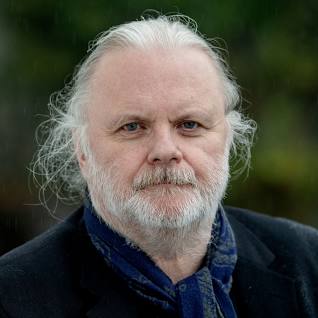
“I just keep the mistakes and let them be wrong, because it’s often the mistakes that eventually lead to something right” Jon Fosse.
● His life and background
Jon Fosse was born in 1959 in Haugesund, Norway, and grew up in Strandebarm. His family were Quakers and Pietists, which he credits with shaping his spiritual views. A serious accident at age seven brought him close to death; the experience significantly influenced his writing in adulthood. He started writing around the age of twelve, despite Fosse’s claims that he was not very concerned with books. As a teenager, Fosse was interested in becoming a rock guitarist, and he began to dedicate more time to writing once he gave up his musical ambitions. He also
played the fiddle, and much of his teenage writing practice involved creating his own lyrics for musical pieces. Growing up, he was influenced by communism and anarchism and has described himself as a “hippie”.
Fosse enrolled at the University of Bergen and studied comparative literature during which time he began writing in Nynorsk.His debut novel, Raudt, svart (Red, Black), was published in 1983 and was influenced by the Nynorsk writer Tarjei Vesaas. The novel contrasted with the social realist fiction popular in Norway at the time and emphasised linguistic expression rather than plot. He published a second novel, Stengd gitar (Closed Guitar) in 1985 and a poetic cycle, Engel med vatn i augene (Angel with Water in Its Eyes) in 1986.He gained a master’s degree in comparative literature in 1987, again from the University of Bergen, and published his third novel, Blod. Steinen er (Blood. The Stone Is).Following his separation from his wife in 1989, Fosse published a novel and his first collection of essays. In the early 1990s, he continued to publish novels and worked with his second wife, Grethe Fatima Syéd [no], on a number of translation.
Fosse’s first play, Og aldri skal vi skiljast (And We’ll Never Be Parted), was performed and
published in 1994. Fosse has written novels, short stories, poetry, children’s books, essays, and plays. His works have been translated into more than forty languages. Between working on his novels, Fosse works as a translator on other authors’ works.
● His style
Despite Fosse’s minimalist style, his works are imbued with a wealth of emotion and depth. His sparse language packs a powerful punch, revealing the often unspoken truths of the human experience. Through his novels, plays, and poems, Fosse captures the complexity of relationships, highlighting the nuanced and sometimes conflicting emotions that lie beneath the surface of our interactions. In doing so, he explores the universal themes of love, loss, and longing, resonating with readers from all walks of life.
● Fosse’s literary achievements
He has received numerous awards and achievements. Such as:1992 Nynorsk Literature
Prize,1996 Ibsen Prize,1997 Aschehoug Prize,1999 Søren Gyldendal Prize,1999 Dobloug
Prize,2000 Nestroy Theatre Prize,2000 Nordic Playwright Prize,2003 Norsk kulturråds
ærespris,2003 Nynorsk Literature Prize,2003 Chevalier of the Ordre national du Mérite of
France (2003),2004 Diktartavla Prize,2005 Brage Prize,2005 Commander of the Royal
Norwegian Order of St. Olav,2006 Anders Jahres Culture Prize,2007 The Swedish Academy
Nordic Prize,2007 The Federal Ministry of Family Affairs’ Deutscher Jugendliteraturpreis,2010
The Ibsen Award,2012 Target Prize,2014 European Prize for Literature,2015 Nordic Council Literature Prize,2016 Willy Brandt Prize,2019 Nynorsk Literature Prize,2021 Brage Prize for fiction, and the 2023 Nobel Prize in Literature ” for his innovative plays and prose which give voice to the unsayable”.
In his own words, Jon Fosse has stated that ‘literature is a way to stand still, to slow down, to perceive and reflect’. It is clear that his works have accomplished this goal, providing a space for introspection and contemplation, while also evoking strong emotions and inspiring critical thinking. His legacy will surely continue to have an impact on future generations, just as his work has already touched the lives of so many. With his pen, Fosse has left an indelible mark on the world, and his impact will surely endure,
 NASELS Press University of Ibadan
Leave a comment